

Stories from a Global Career
Throughout his career, Simon Penney has worked under several business names and held senior professional, regulatory and academic roles.
Every role and assignment has a distinct story of places, people, challenges and opportunities for practical change.
This collection shares some of these stories, illustrating Simon’s experience in waste management, the circular economy, climate change and international development.
The organisations below may have engaged or employed Simon, joined a wider programme, or received support through an assignment commissioned by another organisation. Inclusion does not imply a current commercial relationship or endorsement.
Supporting Post-Tsunami Recovery in Eastern Sri Lanka
Working with the Japan International Cooperation Agency, the Government of Sri Lanka and Kalmunai Municipality, Simon supported waste and resource-management initiatives after the 2004 Indian Ocean tsunami.
The work included:
- Assessing local environmental conditions
- Identifying practical waste-management improvements
- Supporting livelihoods linked to waste recovery and resource use
- Contributing to environmental assessments
- Balancing immediate recovery with long-term development
The assignment took place in politically unstable eastern Sri Lanka, where communities were recovering from the tsunami amid a long-running civil conflict.
This complex environment demanded cultural sensitivity, adaptability and recognition that waste management extends beyond infrastructure to livelihoods, resilience, public health, environmental protection and long-term recovery.
“Thank you for your participation and cooperation for our tsunami project. Though the allocated time was limited, you covered a wide scope of work and compiled the required information for preparation of the implementation program.”
Toshikazu Tai, Team Leader, RRDP-NE Tsunami Relief Projects, Japan International Cooperation Agency, Sri Lanka

Supporting New Plastics Regulations in Grenada
In 2022, Simon supported the Government of Grenada on work commissioned by the International Union for Conservation of Nature under its Plastic Waste Free Islands initiative.
The assignment supported stakeholder engagement on introducing and implementing new packaging and single-use plastics regulations.
Combining desk research with fieldwork in Grenada, it identified the legislation’s practical implications for government, businesses and other stakeholders.
Simon also developed and delivered specialist training for businesses and corporate stakeholders, covering:
- The legislation’s background and purpose
- Regulatory responsibilities
- Practical implementation approaches
- Business preparedness
- Compliance and enforcement
- The transition from problematic plastics
The project demonstrated Simon’s ability to turn environmental policy and legislation into practical guidance, helping regulators, businesses and communities understand what was changing and how to support implementation.
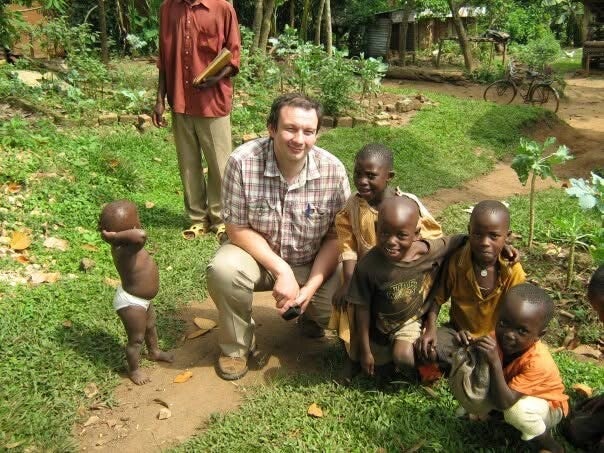
In the Foothills of Mount Elgon, Uganda: Carbon, Farming and Livelihoods
This photograph was taken during Simon’s work in Uganda, in the foothills of Mount Elgon, reviewing the carbon balance of livestock for the development charity then known as Send a Cow, now Ripple Effect.
The assignment brought a technical environmental question into the everyday setting of rural life. Assessing livestock’s carbon balance requires careful attention to the farming system around the animals, alongside an understanding of the role livestock plays in household livelihoods.
Ripple Effect’s approach recognises the connections between livestock, crops and soil fertility, including the use of manure to support food production. Its work with farming families illustrates why environmental assessment benefits from looking at these relationships together.
The photograph offers a human context for that work. Behind every carbon calculation are people, families and decisions about the future. Responsible environmental advice must take climate impacts seriously while also respecting local knowledge and the need for secure food supplies and sustainable livelihoods.
Photograph: Simon Penney with children during a visit to Uganda’s Mount Elgon foothills, while reviewing the carbon balance of livestock for Send a Cow, now Ripple Effect.

Metro Vancouver Wood Waste Strategy, Canada.
Through his former practice, Promise Consulting, Simon Penney contributed to a 20-year strategic assessment of wood-waste management for Metro Vancouver.
The work combined GIS spatial analysis, material-flow and systems assessment, infrastructure planning, logistics and end-market development. It examined wood-waste sources; collection and separation; required transfer and processing infrastructure; transportation and catchments; and markets supporting long-term recovery.
The assessment recognized distinct streams, from clean lumber and pallets to engineered, painted and treated wood. It considered differentiated collection, processing, quality control and market routes, rather than treating wood as a homogeneous material.
A central focus was the relationship between regional infrastructure and sustainable market demand. Potential outlets were assessed within a resource hierarchy: prevention, salvage, reuse, remanufacture, recycling, biomass applications and controlled management of unsuitable residuals.
Simon also supported dissemination through stakeholder workshops. These sessions communicated findings, gathered practical insight, tested assumptions and encouraged understanding of the infrastructure, operational and market changes required. They connected the technical assessment with the experience and priorities of organizations generating, collecting, processing, regulating and using recovered wood.
The resulting framework linked long-term policy ambitions with stakeholder knowledge and the facilities, logistics, market capacity and implementation sequencing needed for a resilient regional wood-resource system.

Higher Education and Curriculum Development
During his doctoral studies at Queen’s University, Ontario, Canada, Simon Penney developed teaching materials and taught undergraduate Environmental Science. He also completed a postgraduate pedagogy course, strengthening his expertise in curriculum design, inclusive teaching, assessment and effective educational practice.
Simon later developed and delivered postgraduate materials for Conestoga College and Fleming College in Ontario. Drawing on extensive experience in waste and resource management, environmental policy, sustainability and the circular economy, his teaching connected academic principles with professional practice and real-world case studies.
As a guest lecturer at the University of British Columbia, he has shared specialist knowledge and practical insights with university students.
This blend of curriculum development, undergraduate and postgraduate teaching, pedagogical study and guest lecturing demonstrates Simon’s ability to make complex environmental subjects accessible, engaging and professionally relevant.
Additional Stories
Further examples from Simon’s international career will be added over time.
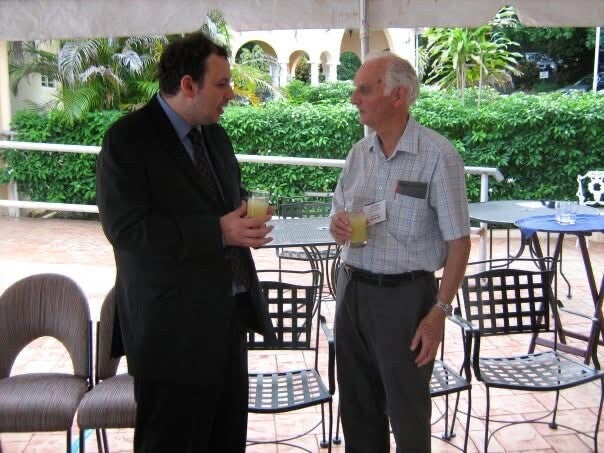
Meeting Sir John Houghton FRS: Science, Faith and the Care of Creation
At a conference on faith and environmental stewardship in Jamaica, Simon had the honour of meeting Professor Sir John Houghton FRS, a distinguished climate scientist and committed Christian whose work connected scientific understanding with a profound sense of responsibility for the Earth.
Sir John studied physics at Jesus College, Oxford, where he completed his undergraduate degree and doctorate before later becoming Professor of Atmospheric Physics at the University of Oxford. Elected a Fellow of the Royal Society in 1972, he went on to lead the UK Met Office as its Chief Executive from 1983 to 1991. He was knighted in 1991 in recognition of his contribution to science.
As Chair and Co-Chair of the Intergovernmental Panel on Climate Change’s scientific Working Group I between 1988 and 2002, Sir John guided its first three scientific assessments. His leadership helped establish the foundations for the IPCC’s work, which was recognised in 2007 when the organisation shared the Nobel Peace Prize with Al Gore. The IPCC has acknowledged Sir John’s contribution as a major factor in that recognition.
He was also a co-founder of the John Ray Initiative, established in 1997 to bring together scientific and Christian understanding of the environment and encourage practical stewardship. His life demonstrated how rigorous scientific enquiry and deeply held faith could inspire a shared commitment to protecting creation and serving others.
This photograph records an opportunity to meet a remarkable man whose contribution reached far beyond his own discipline. It is shared with deep respect for his life and legacy: a reminder that knowledge carries responsibility, and that caring for the world is both a practical task and a moral calling.
Photograph: Simon Penney with Professor Sir John Houghton FRS at a conference on faith and environmental stewardship in Jamaica.
Create Your Own Website With Webador