

Maritime Carbon Intelligence in Africa
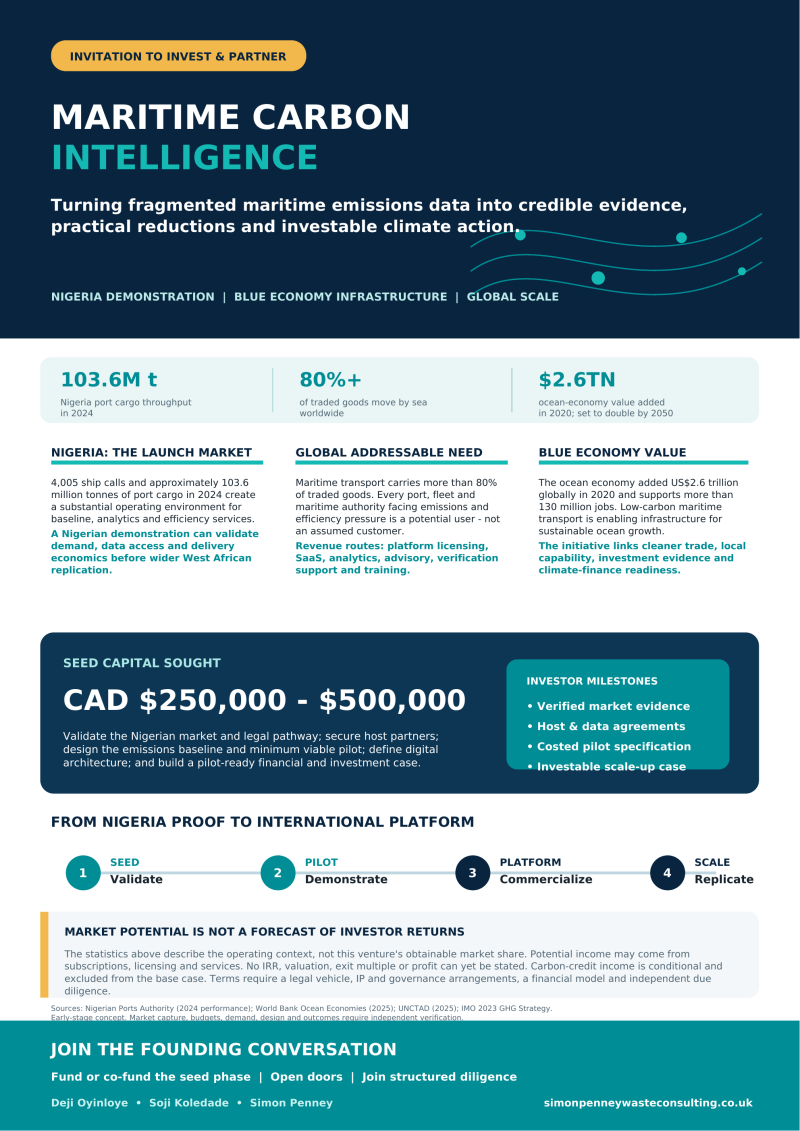
Turning fragmented maritime emissions data into credible evidence, practical action and investable climate opportunities
Simon Penney Waste Consulting is supporting the early development of an African initiative on maritime emissions data, carbon intelligence and practical emissions reduction.
Maritime activity is vital to trade and economic development, yet emissions from ports, vessels, freight, cargo handling and supporting infrastructure can be difficult to quantify.
Relevant information is often held by different organisations, recorded in incompatible formats or collected inconsistently. This makes it harder for governments, port authorities, businesses, investors and development partners to establish credible baselines and identify effective interventions.
The proposed initiative would bring fragmented data together to deliver:
- Credible emissions evidence, baselines and performance indicators
- Practical emissions-reduction opportunities
- Better-informed policy and investment decisions
- Potentially investable climate projects
- Improved monitoring, reporting and verification
- Stronger institutional and technical capacity
Proposed Initial Demonstration
The initiative is exploring an initial demonstration in Nigeria.
Subject to stakeholder interest, technical assessment and funding, it could examine selected maritime activities and develop a practical methodology for:
- Identifying emissions sources and mapping available data
- Assessing information gaps and developing an emissions baseline
- Identifying technically and economically realistic interventions
- Evaluating environmental, commercial and social benefits
- Establishing monitoring and reporting arrangements
- Exploring climate-finance and investment pathways
The demonstration would generate practical learning for wider application in Nigeria and potentially other African maritime contexts.
Areas of Potential Application
Depending on participating organisations' needs, the work could consider emissions from:
- Port operations and energy use
- Commercial vessels, harbour craft and service vessels
- Cargo handling, freight and logistics
- Warehousing and storage
- Waste and resource management
- Fuel use and alternative-energy options
- Supporting transport infrastructure
The scope would be agreed with stakeholders and adapted to the availability and reliability of local data.
Potential Participants
The initiative may be relevant to:
- National and regional governments
- Port and maritime authorities
- Shipping and logistics businesses
- Development- and climate-finance institutions
- Research institutions, universities and consultancies
- Data and technology providers
- Investors, project developers and international-development organisations
Opportunities for Collaboration
Simon welcomes exploratory conversations with organisations and specialists able to contribute:
- Maritime and port-sector expertise
- Greenhouse-gas accounting, environmental data and digital systems
- Monitoring, reporting, verification, policy and regulation
- Engineering and emissions-reduction technologies
- Climate finance and investment
- Nigerian and wider African institutional knowledge
- Programme development and implementation capacity
The objective is to combine local knowledge, technical expertise, institutional participation and financial capability.
Current Status
Maritime Carbon Intelligence in Africa is an early-stage concept. Its scope, governance, partners, funding and implementation arrangements are not yet finalised.
Create Your Own Website With Webador